
Your Favorite Band Has Nothing to Say
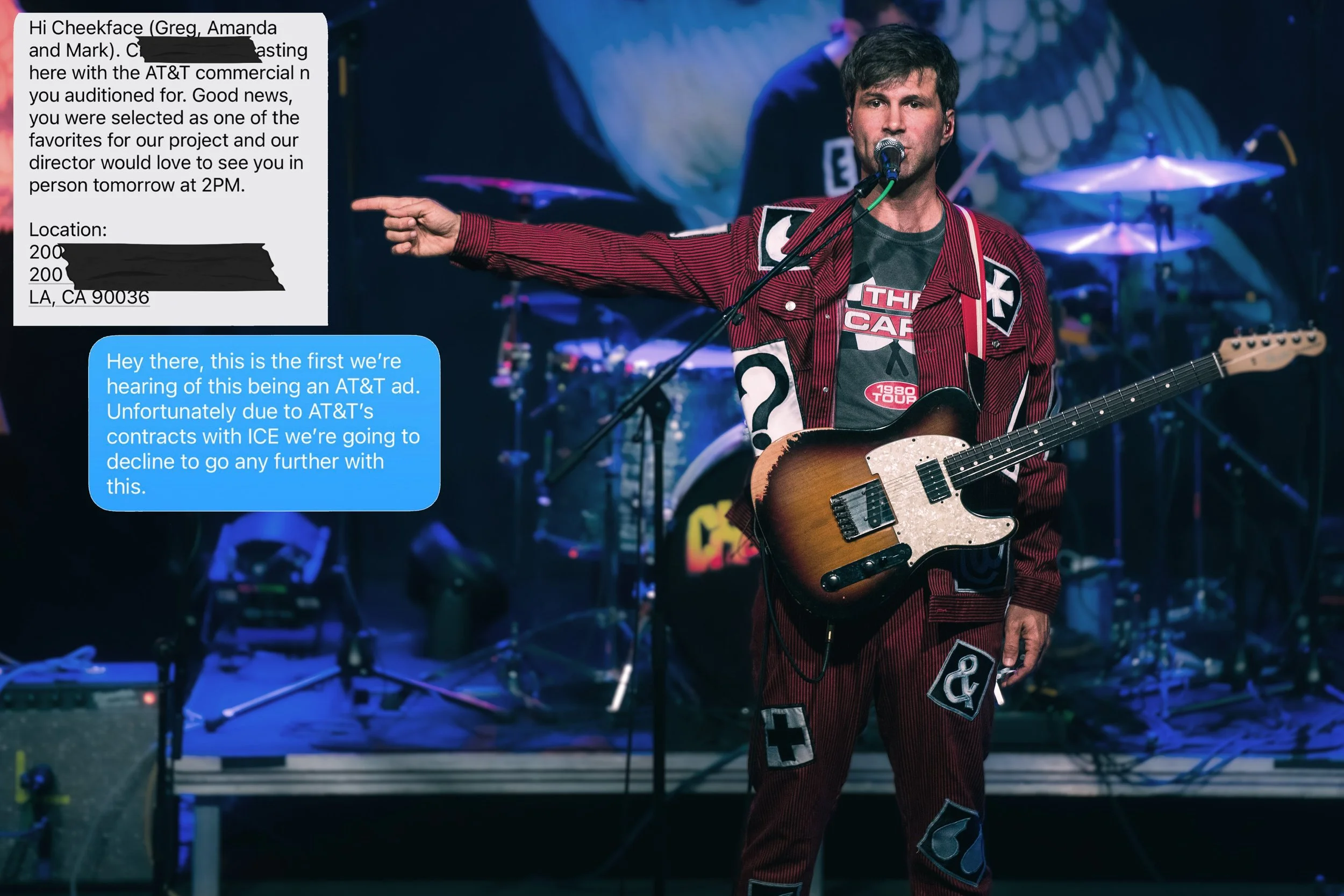
Photo credit: Nathan Smith
There's a text message making the rounds on Threads.
Or at least it was, briefly, before Cheekface posted it to Instagram and the indie internet quietly went a little feral about it. A casting director reaches out to the Los Angeles trio, says they're “one of the favorites" for a project. Big money. Come meet the director. The project, it turns out, is an AT&T commercial.
And Cheekface said: No.
Not a quiet no, either. The band published the exchange, declined the opportunity and explained that AT&T holds a 10-year, $146 million contract with the Department of Homeland Security to provide communications infrastructure to ICE and CBP.
For a band of their size, beloved by a devoted indie audience, but not exactly headlining arenas, that kind of money isn't just symbolic. It’s life changing. It could fully fund a tour, or the next album cycle. It means something real to turn it down. And that, right there, is the point.
Americans are living through one of the most politically charged moments in decades. ICE has been deployed across the country with an aggression that has left communities shaken, resulted in the deaths of U.S. citizens, including the tragic killing of Renée Good and Alex Pretti during Operation Metro Surge in Minneapolis.
Gaza remains in the grip of a humanitarian catastrophe that has now drawn a formal genocide finding from a UN independent commission. Gun violence continues. The machinery of American life is grinding loudly, and people are scared.
So what does your favorite arena-filling artist have to say about any of it? Probably nothing.
This is the silence that makes the noise of smaller artists so deafening by contrast. Because while some stadium-packers are focused on brand deals, staying neutral, and protecting their streaming numbers, bands with far less insulation are making the kind of decisions that actually cost something.
The Punks Are Doing Their Jobs
Nobody has been louder than Dropkick Murphys frontman Ken Casey, who has spent the past several months publicly baffled that more bands, especially punk bands, aren't saying a word. “You're going to get to this moment where some lunatic wants to end our democracy," Casey told the Boston Globe last fall. “And most punk bands have decided to just keep their head down and stay quiet and hope this all blows over because they don't want to affect their business."
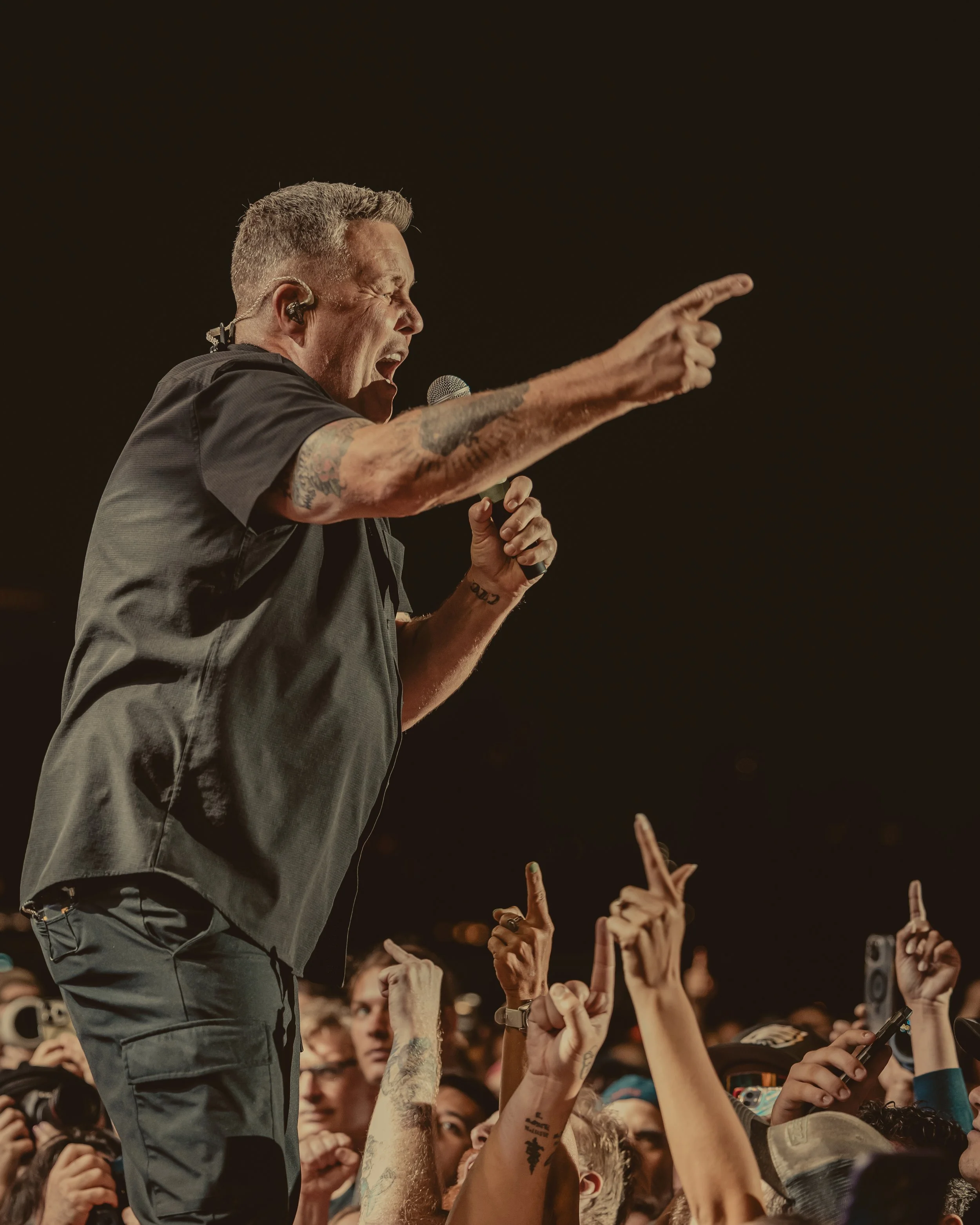
Dropkick Murphys’ front man Ken Casey.
Photo Credit: Ryan Reid
Dropkick Murphys have backed it up with action. They reworked their 2005 song “Citizen C.I.A." into “Citizen I.C.E." with new lyrics include the pointed line: Too scared to join the military // Too dumb to be a cop and debuted it live in the U.S. in February, with Casey leading the crowd in a “F*CK ICE" chant before launching into it. Their recent St. Patrick's Day tour featured the song nightly, with Boston-area band Haywire joining them on the track. The two acts pressed a joint split LP, New England Forever, that was available exclusively at shows.
Casey has also been explicit that speaking out comes with real costs. He's acknowledged losing fans, getting trolled, catching grief online. His response was, “The water's fine," he told Consequence. “Come on in. Nothing to be scared about."
He's now building a coalition called Down for the Cause of Saving Democracy alongside Rise Against, hoping to give hesitant bands a larger umbrella to speak under. The idea is that strength in numbers might lower the personal stakes for artists still on the fence.
Rise Against joining the effort isn't a surprise. They've built a career on this kind of thing. Neither is Motion City Soundtrack singer Justin Pierre, who has been posting ICE agent locations and writing about the Minneapolis killings in deeply personal terms. The neighborhood where agents killed Alex Pretti, he noted, is streets away from where he and his wife got married.
Bright Eyes' Conor Oberst showed up to social media with an acoustic guitar marked “UNMASK ICE" and a simple message: “There is no more time for capitulation." Green Day has been calling out ICE from the stage on their current run, reworking “American Idiot" lyrics in real time. Tom Morello organized a Concert of Resistance & Solidarity to Defend Minnesota in Minneapolis. The list grows weekly.
The Grammy Moment, and Who Said Nothing
The 2026 Grammys offered the clearest possible picture of where things stand. Billie Eilish, who'd been openly calling for artists to speak up on social media, used the ceremony to do it herself, ending her acceptance speech with a direct “F*CK ICE" while wearing an “ICE Out" pin. Bad Bunny won Album of the Year and made the most of the platform.
Kehlani accepted her R&B award and told the room, “Together, we are stronger in numbers to speak against the injustice going on in the world right now." Shaboozey dedicated his award to “all children of immigrants." Joni Mitchell, Brandi Carlile, Jason Isbell, Carole King, Margo Price, and Rhiannon Giddens all wore the pin on the carpet.
They were the exceptions. For every artist who said something, there were dozens who said nothing, who accepted their awards, thanked their labels, waved, and went back to posting about their upcoming tour. The “ICE Out" pins were easy to wear and many still didn't.
That's a choice.
What It Means When It Costs You Something
The Cheekface situation is interesting precisely because of its scale. This wasn't Billie Eilish turning down a partnership, it was a smaller band walking away from what they described as “really significant" money. They didn't have to say anything about it. They could have just declined quietly and moved on. Instead they posted the receipts, named AT&T, and explained the connection to ICE and DHS in plain terms.
Their upcoming album, Podium, will sell to exactly the audience it was always going to sell to. The AT&T money would have reached a different one. That's the gamble, and they made it knowingly.
This is the texture of resistance that doesn't get celebrated the way a Grammy speech does. It's not broadcast to 15 million people. It lands in an Instagram caption, gets picked up by Stereogum, filters through a few thousand retweets, and then the band goes back to making music and waiting to see what happens. For a lot of smaller artists, that's the whole loop, you say the thing, take the heat, and keep going.
The Silence Is Loud
There's a version of the argument that says artists shouldn't have to be activists, that we shouldn't require musicians to be political, that everybody has a right to just make art. Fine.
But that argument has always had a class dimension to it. The artists with the most to lose by staying quiet are often the ones staying loudest, because they've long understood that silence in a moment like this isn't neutral. And the artists with the most insulation, the biggest platforms, the least financial vulnerability, are often the quietest. They can afford the silence. Literally.
Ken Casey said it well: Punk rock was built on exactly this moment. The Clash. The Dead Kennedys. Fugazi. Minor Threat. These weren't artists who waited for things to calm down before deciding whether to say something. The whole point was to say the thing while it was uncomfortable to say it.
Cheekface are not a punk band. They make scratchy, clever, talk rock. They are, in that sense, an unlikely political symbol. But here they are, turning down AT&T money on principle and posting the conversation so everyone can see exactly why.
In a world this loud with silence from the people who could afford to be loud, that's worth something.
Actually, it's worth a lot.
Follow Cheekface on Instagram. Their new album Podium is forthcoming.
